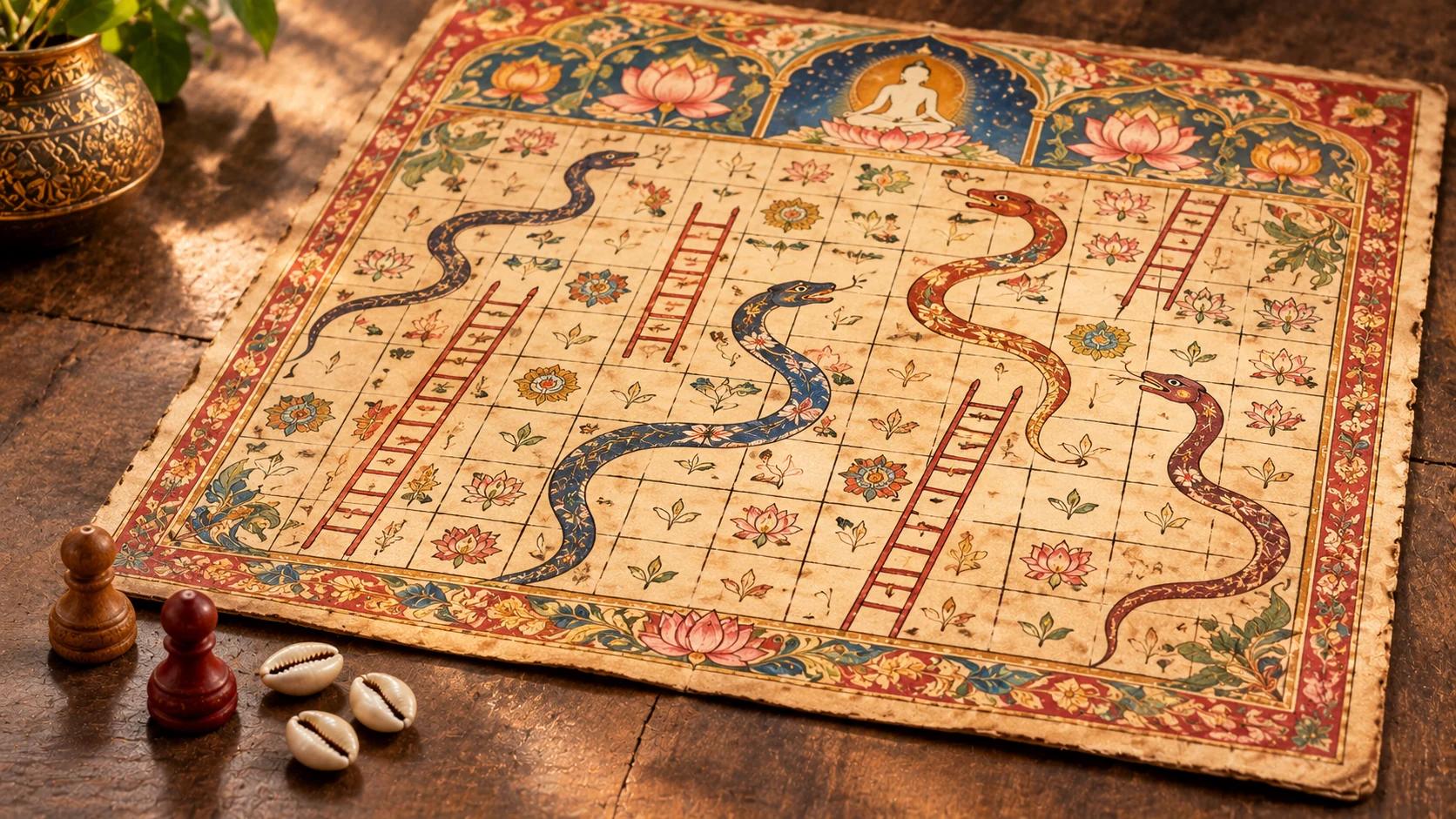
Almost all of us grew up playing Snakes & Ladders. Very few of us know that it began in India as Moksh Patam, a game of knowledge in which every ladder is a virtue, every snake is a habit of the mind, and the final square is moksha, liberation. In this article I'll share where the game comes from, what its ladders and snakes stand for, and how you can play it as a gentle mirror for your own life, at home or in a session with me.
What is Moksh Patam?
Moksh Patam, also written Moksha Patam, is a traditional Indian board game of spiritual teaching. The name joins moksha, liberation from the cycle of birth and rebirth, with patam, a board or path. It has been known by many names across India: Gyan Chaupar, the game of knowledge, in the north; Paramapada Sopanam, the ladder to the highest place, in the south; and Leela, the divine play, in some yogic traditions.
The board is a journey through the states of human life. Each square stands for a quality, an emotion or a stage of awareness. Players move by chance, with cowrie shells or dice, and wherever they land, the square has something to teach. Ladders lift you towards liberation, and snakes carry you back down.
Every roll of the dice is chance. Every ladder and every snake is a choice.
An ancient lesson in karma
Popular tradition credits the 13th-century poet-saint Gyandev, also known as Sant Dnyaneshwar, with shaping the game as a way to teach children about karma, though versions of it are found across many Indian traditions, including Hindu, Jain and Sufi boards. In parts of South India, families still play Paramapada Sopanam through the night of Vaikuntha Ekadashi as a devotional vigil.
The teaching at its heart is simple and profound. The dice are destiny, the circumstances we did not choose. The ladders and snakes are karma, the results of how we respond. Two people can roll exactly the same number and arrive at very different squares, because of what they have cultivated along the way.
In the late 1800s the game travelled to Victorian England, where it became Snakes & Ladders, and later to the United States as Chutes and Ladders. Along the way its spiritual meaning was gradually set aside, and it became the children's game most of us know today.
What the ladders and snakes stand for
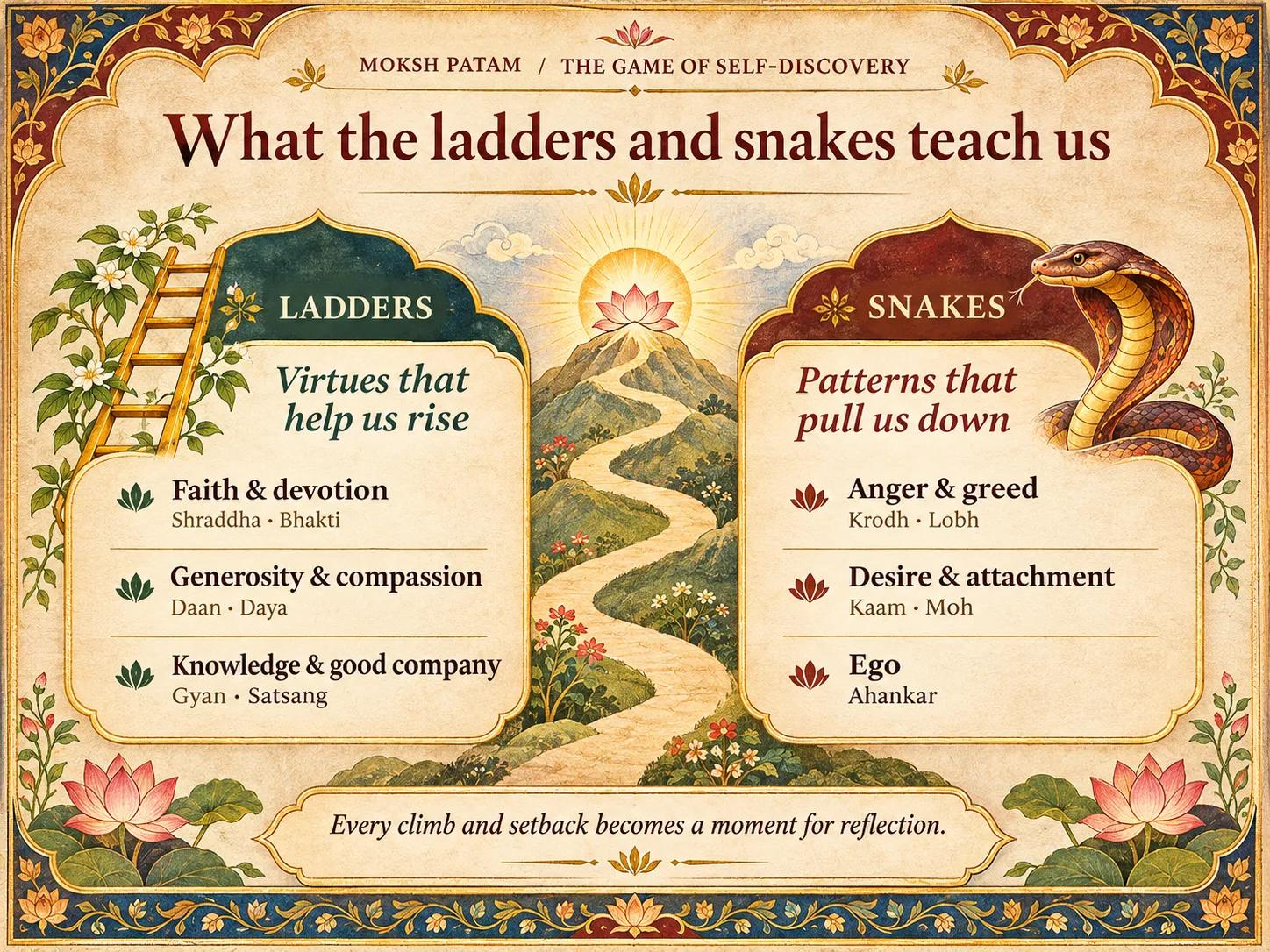
Boards differ from one tradition to another, but the same themes appear again and again. The ladders are virtues that lift us quickly when we practise them. The snakes are the inner patterns that pull us down, often the ones Indian traditions name as the five great obstacles: desire, anger, greed, attachment and ego.
- Ladders: faith (shraddha) and devotion (bhakti): trusting something larger than yourself, and offering your actions with love.
- Ladders: generosity (daan) and compassion (daya): giving freely, and meeting others with kindness.
- Ladders: knowledge (gyan) and good company (satsang): seeking wisdom, and choosing people who bring out your best.
- Snakes: anger (krodh) and greed (lobh): reacting before thinking, and never feeling that you have enough.
- Snakes: desire (kaam) and attachment (moh): craving that never settles, and holding on to what is ready to change.
- Snakes: ego (ahankar): the pride that tells you that you have already arrived.
On many traditional boards the snakes outnumber the ladders, and one of the longest snakes sits close to the very top. It is a striking reminder that pride can undo a long journey just when we feel we are nearly there.
Why a game of chance teaches so much
Moksh Patam works because it feels like play. When we are simply rolling dice, our guard comes down, and we notice our reactions honestly: the frustration of sliding down a snake for the third time, the relief of a ladder, the impatience to reach the end.
Those reactions are the real teaching. They mirror how we meet setbacks and good fortune in daily life. A setback is not the end of the game, only a return to a square we have something left to learn from. And no single roll decides the outcome; it is how we keep moving that matters.
Play it as a reflection at home
You can turn an ordinary Snakes & Ladders board into a simple reflective practice. Allow about half an hour, and keep a notebook beside you.
- Before you begin, write down one question or area of your life you would like clarity on.
- Give each ladder on the board the name of a virtue, and each snake the name of a pattern you recognise in yourself. Write them on small slips of paper if it helps.
- Play slowly. Each time you climb a ladder, note one recent moment when you lived that virtue.
- Each time you slide down a snake, ask gently where that pattern showed up for you this week, without judging yourself.
- When you reach the final square, read through your notes and choose one virtue to practise in the week ahead.
Play it with your children too. Naming the ladders "kindness" and "sharing" and the snakes "anger" and "telling lies" turns a family game into a lovely, natural conversation about values, which is how the game has long been used.
A Moksh Patam session with me
In a session, the game becomes a mirror for your life right now. We begin with your intention, what you would like clarity on. As the game unfolds, I read the squares you land on, the ladders you climb and the snakes you meet as reflections of your journey: where you are rising, where you keep slipping, and the choices quietly shaping your path.
You don't need to know how to play, and you don't need any particular belief. Sessions are often light and engaging, yet they tend to surface surprisingly deep insight. In person is ideal, and sessions can also be guided online. You can read more on the Moksh Patam session page.
If the same lesson keeps returning to you in different disguises, an Akashic Records reading offers another way to understand those deeper patterns.
Carrying the lesson into your days
The insight from a game stays alive when you give it a small daily shape. Choose the one virtue you want to grow and the one pattern you want to loosen, and write both somewhere you will see them each morning.
Many people also like to mark the shift with a simple ritual of release: naming the pattern they are ready to let go, with a focal point such as Bandhan Mukti ritual oil, or lighting a stick of Sacred Temple dhoop at evening prayer as a quiet reminder of the path they have chosen.
Frequently asked questions
Is Moksh Patam the same as Snakes & Ladders?
Snakes & Ladders comes from Moksh Patam, but the original is a spiritual teaching game. Its squares, ladders and snakes carry meaning, and its goal is moksha, liberation, rather than simply reaching square 100 first.
Do I need to believe in karma to benefit from it?
No. You can simply treat the game as a mirror for your habits and choices. Many people find the reflection valuable whatever their beliefs.
Can Moksh Patam predict my future?
It isn't a fortune-telling tool. It reflects the patterns already at work in your life and shows how your choices shape where you go next.
Can a Moksh Patam session be done online?
Yes. In person is ideal, and sessions can also be guided online. Ask about a session to find what suits you best.
Is it suitable for children?
As a family game at home, absolutely. Naming the ladders and snakes after virtues and habits is a gentle way to talk with children about values and consequences.

Founder of Mystical Auras, Tarot and Akashic Records reader and certified healer with more than ten years of practice. Named Best Tarot Card Reader at the National Icon Awards 2022 and Akashic Record Reader of the Year at the Global Business Awards 2024, she reads, heals and teaches online and in person. More about Ruchi
Explore this with Ruchi
An ancient game that mirrors your life's path. Moksh Patam sessions run online worldwide or in person. Have a question first? Message her on WhatsApp.